 University of North Texas

Screen Reader Integration with Notation Software
Areas Assisted:
- Visual Impairment
Possible Applications:
- Theory/Analysis/Pedagogy
- Composition
MuseScore is an open source and free notation software available online which comes with support for screen readers and braille. However, MuseScore's support for JAWS is not currently as good as it is for Narrator or NVDA on Windows.
See MuseScore’s Accessibility Page for a guide to accessibility, focusing on navigation and usage with screen readers. For a guide to MuseScore's Braille integration, see MuseScore Braille Overview. Finally, we reccomend joining MuseScore Accessibility Group via Groups.io to connect with a community of dedicated users who offer guidance on accessibility techinques in the software as well as reporting on current accessibility issues/bugs in current releases.
MuseScore for Score Reading
Using MuseScore files you can present score excerpts, musical examples, and even exercises to students via screen readers. You can create examples yourself in MuseScore, or provide previously created files such as MusicXML.
Students relying on screen readers can refer to the MuseScore Accessibility Page for guidance on MuseScore - Navigating the Score.
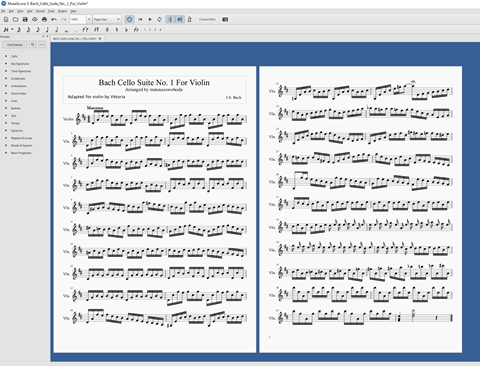
MuseScore for Note Input and Composition
MuseScore’s functionality as notation/engraving software is fully accessible with the supported screen readers. Students relying on screen readers will be able to use MuseScore for composition elements as well as many theory assignments relying on note input (intervals, harmonization, counterpoint, etc.). For theory assignments, you may likely need to recreate or modify the assignments into MuseScore files if they are sourced from worksheets or other sources. (Be sure to privately hold these materials for screen reader users to request so as to maintain Copyright Compliance).
Students relying on screen readers can refer to the MuseScore Accessibility Page for guidance on Muse Score - Navigating the UI.
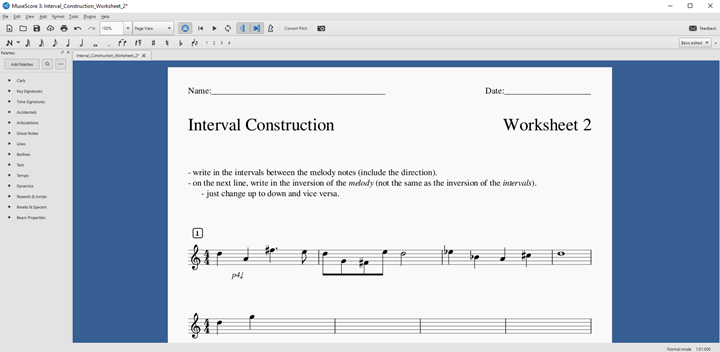
Considerations for Screen Reader Integration
- This is perhaps the best and most cost effective way to offer score interaction and composition for students with screen readers. The process may prove longer when using a screen reader, so completion time may need to be extended for in-depth assignments.
- Preparation time may be required to either retrieve or create necessary examples/scores/assignments.
- There are many existing scores available created by the MuseScore community, but some may require purchasing on the MuseScore community site. One of the best options may be to rely on MusicXML files instead.
- In all cases, be sure to review these scores in MuseScore to ensure accuracy for your students.